


 Wendy Covey
Finding and keeping top-notch content marketing professionals is not an easy task for technical companies. Learn about the top traits of an A-player, recruiting the perfect purple unicorn, and how to keep your marketing staff motivated and equipped to do their best work.
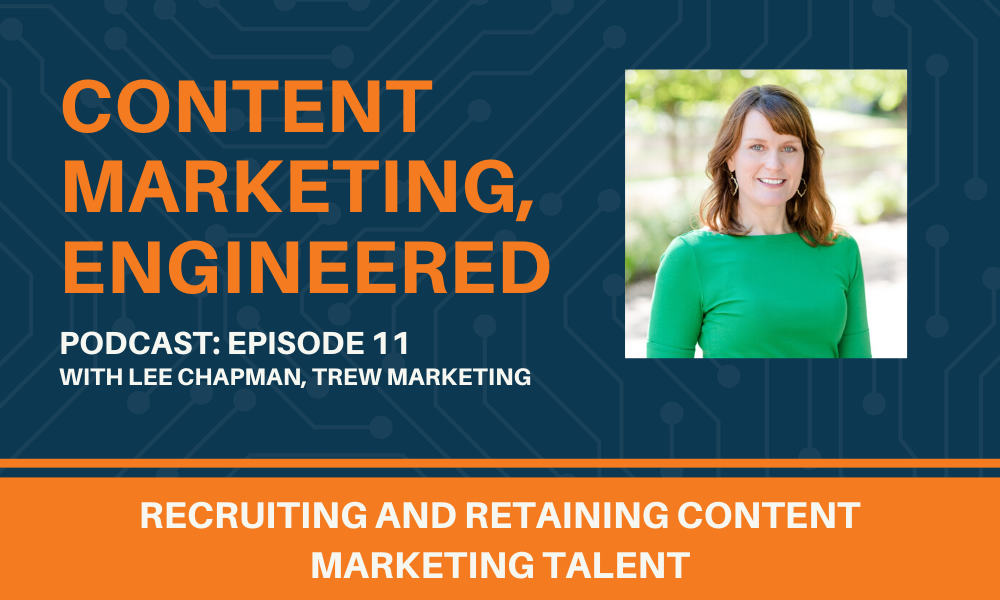


Lee Chapman, TREW Marketing President, has been managing content marketing teams, or "word nerds," at technical companies through the majority of her career. She has incredible instincts, honed with years of practice at recruiting, training, mentoring, and keeping marketers happy.
On this episode she describes the perfect A-player content marketer, which based on the make up of the team, may be found in one person or several speciality positions. Skilled content marketers craft engaging stories unique to the company, with a sharp attention to detail. They facilitate discussions with subject-matter experts, even stalking them when necessary to stay on deadline with reviews. They understand the importance of content packaging and visual presentation as the means to promote content and convert at a higher rate.
Finding this perfect "purple unicorn" is not simple or easy. Lee suggests using situational questions to feel out a candidate's thought process and ability to think on their feet.
Lee and I recorded this podcast from our respective home offices, but she relocated in order to have better sound quality -- to her bedroom closet! This is the second time in recent weeks I'm reminded of how an ironing board makes for an excellent adjustable desk.
Transcript
Speaker 1: [00:00:00] Finding and keeping top notch content marketing professionals is not an easy task for technical companies. On this episode, I'm joined by Lee Chapman, who is both highly experienced and highly talented at recruiting, training, mentoring and keeping content marketers happy. Together, we discuss the top traits of an A player recruiting the perfect purple unicorn and provide advice on how to keep your marketing staff both motivated and equip them to do their best work. Let's do this. [00:00:33][33.0]
Speaker 2: [00:00:36] Welcome to Content Marketing engineered. Your source for building trust and generating demand with technical content. Here is your host, Wendy Covey. [00:00:45][9.5]
Speaker 1: [00:00:50] Hi and welcome to Content Marketing Engineered. On each podcast episode, I'll break down an industry trend challenge or best practice in marketing to technical audiences. You'll meet colleagues and industry friends of mine who will stop by to tell you their stories along the way. My goal is that you leave each episode feeling inspired and ready to take action. Before we jump in, I'd like to give a quick shout out to our sponsor, True Marketing. True is a content marketing agency based in beautiful Austin, Texas, and serves companies focused and technical industries. For more information, visit True Marketing Dotcom. And now on with our podcast. Well, joining us today is Lee Chapman, vice president of account services from Chew Marketing Highly. [00:01:35][45.3]
Speaker 3: [00:01:36] Hi, Wendy. Thanks for having me on. You bet. [00:01:39][2.4]
Speaker 1: [00:01:39] Glad you're here. And for those of you listening, Lee and I are recording this episode during the unique time of COVID 19 Shelter in place. So let's start with how you're doing, how your family's doing through all of this. [00:01:54][14.8]
Speaker 3: [00:01:56] Thanks, Wendy. Yeah, interesting times, right? Whoever thought we'd be, you know, hunkered down in our houses, worried about where we're going to get our toilet paper from the store tomorrow. So I'm happy to tell you, we're fully stocked with toilet paper, so don't worry about us on that front. But, you know, right now, I'm in fact, I'm speaking to you from my closet. Luckily, last year we had our master bathroom closet remodeled and I happen to have an electric outlet in here, so I'm all plugged in. I've got my double monitors. I'm working on an adjustable makeshift desk, that is, to be honest, and ironing board and handling that right now. But who's going to be ironing during this? So. [00:02:37][41.4]
Speaker 1: [00:02:38] No, no. And who irons anyway? Really. Oh. [00:02:40][2.4]
Speaker 3: [00:02:41] Really. That's so that's. Yeah, but we're all doing fine. Thanks for asking. [00:02:44][3.7]
Speaker 1: [00:02:45] Great. And you know that closets to the best places to record podcasts anyway, because that's your built in sound studio. So it's perfect. [00:02:52][7.1]
Speaker 3: [00:02:53] Absolutely an added bonus. [00:02:54][1.3]
Speaker 1: [00:02:57] Well, Lee, you and I have worked together at two different companies for, I think, like 14 years now. Is that right? [00:03:04][7.3]
Speaker 3: [00:03:05] I think maybe it's even 15. But, you know, I don't want to just so let's stick with 14. That sounds better. [00:03:10][4.7]
Speaker 1: [00:03:11] Okay. We're so much younger than that. [00:03:12][1.8]
Speaker 3: [00:03:13] Okay. [00:03:13][0.0]
Speaker 1: [00:03:14] But for those of you listening, just maybe, Lee, you could tell our listeners a bit about your career in marketing and the different, you know, stops you've made along the way. [00:03:24][10.3]
Speaker 3: [00:03:26] Absolutely. So, yeah, we worked together, as you said, for a really long time, and we've managed and supported teams at National Instruments, a corporate billion dollar company, all the way down to now, you know, a startup marketing agency. Right. And I knew I just want to say, I have to tell your audience. I knew the first time I met you that you were fierce and a total marketing badass. And I thought, yeah, this is a woman that I went to work with. And, you know, that says a lot, I think because you're a die hard Aggie and I'm a bleeding ranch longhorn. And even though you're an Aggie, I still absolutely enjoy working with your great Yagan. I did let you get that Aggie plug in, so there you go. [00:04:08][41.8]
Speaker 1: [00:04:09] It was a lot to overcome. I understand. Again, thank you for looking past it. [00:04:14][4.8]
Speaker 3: [00:04:14] Yes. So so my marketing career actually started it at National Instruments back in the early 2000. And I was managing a team of technical content writers and editors and, you know, focused on really educating engineers and scientists on all the great products and services that I supported and doing that globally, which was pretty interesting challenge. So we we always laughed that we were hard core word nerds and we had this awesome style guide that we were constantly adding to. And then we had acronyms that we were defining and oh my gosh, I just it takes me back. And we really had honed our stalking skills so that we could ensure that these engineers, who are our subject matter experts on the pieces we were working on, they couldn't avoid our deadlines. And we were not above lurking around meeting rooms where we knew they'd be coming on to meetings, pop out, you know, we had deadlines and, you know, we had to make sure that those those were met. So that was that was really awesome. And we we worked with our international counterparts to manage the translation of our print and digital content. And back then it was in eight languages. And so not only were we kind of preparing for the move to digital and ecommerce, but we we're still producing at the same time a 1000 page print catalog for many years. And then, like I said, working with our web team to start kind of transitioning and moving all that to an eCommerce experience, which was really back in the infancy of, you know, e-commerce website. So that was awesome experience to have. [00:05:50][95.8]
Speaker 1: [00:05:50] Gradually, I remember the controversy of whether or not we should get rid of that catalog and how do we do that and that timeframe. When you were managing both the thousand page catalog and the online content, could you just like just sidebar? Or maybe we'd say that actually that could be a whole nother podcast. Couldn't read. [00:06:09][19.0]
Speaker 3: [00:06:10] Like. Yes, I mean and just the pressure from the sales team, you know, who was so reliant on print for so many years. And that catalog was really their lifeblood. They took it to every site that they went to and they knew all the pages. They were dog eared pages. And I mean, it was a huge team effort across the entire marketing organization and globally to get that piece out and moving to Web. I swear I had sales guys that were like shooting daggers out of their eyes at me as I walked down the halls too. So to do that, but so much more cost efficient, obviously, when we had to make that choice to move to an online experience and invest kind of our resources in that direction. But yeah, that was that was no easy task back in that day. So all of these things, I mean, that was not ever how I envisioned probably my marketing career going, but it was so fast paced in those times and we really felt like we were pioneers, right? In a new age of expanding content from all these traditional print forms to online digital experience, which is really different than when you're crafting and designing things for print content and moving them to digital. And this team that we were working with was so smart, so focused, really highly innovative, and is just one of the best teams that I ever worked out. So that that really stands out when I think back to those times. [00:07:36][85.2]
Speaker 1: [00:07:36] Nice. [00:07:36][0.0]
Speaker 3: [00:07:37] And, you know, one of those challenges on that team was hiring and retaining high performing team members. And I know that's one aspect that we're going to talk a little bit more about as we kind of go go through our talk. And then, you know, in 2012, I decided it's time for a change. And my kids were older. I was really, really looking for a new challenge. And so I joined some of my favorite former and I colleagues at TRU, and it just felt like a great step in my career, moving from corporate to agency, going from an office cubicle setting to a virtual home office, and then learning how to use all these new tools to collaborate with the team and manage projects and juggle multiple accounts and a completely new way of marketing and a whole new service like marketing planning. In fact, when you remember all this early days, you and I spent hours on hours building marketing plans, slide decks and PowerPoint as we sat on airplanes flying across the country. Just was so innovative and a complete, like I said, complete contrast, you know, to what I'd been doing at. And I but now, you know, eight years later, my focus is really managing our team of account managers, writers and designers and our web specialist to ensure that we're getting our all our great marketing and content projects on time and on budget and staying really focused in this, this niche B2B technology space that we're in. [00:09:05][87.7]
Speaker 1: [00:09:06] Yeah, well, Lee, there's absolutely no one better that I've seen at managing high performing teams than you. And you're just you're so talented. You have just the right instincts for it. And of course, that's now been really, if you think about all your years in marketing, really the lion's share of what you've been doing. So I was really excited to bring you on into today's episode and just get in your head a little bit. Learn from that experience on both the corporate side and the agency side to talk about what it takes to retain and recruit top marketing talent. Because it's not easy. It's not easy to find the right people. And it's so important. So so let's start off with what are the types of roles and skill sets needed to be a successful content marketer? And let's talk specifically to technical companies or agencies working with technical companies, because there are some nuances there, right? [00:10:01][55.8]
Speaker 3: [00:10:03] Yes, definitely. So, you know, the types of roles for content marketers, writers, editors, designers, and what's really key across all of these roles is the ability to be able to craft and tell really compelling stories that help engage these technical audiences, along with having great attention to detail, understanding how like written and visual content combines. That's so important right now, especially with the high expectations that everyone has and short attention spans. Write that that the content is worth investing their time in consuming content growing exponentially. There's new sites popping up. People are spitting out more content than ever before. So not only do you have to have a team that can help meet that cadence and have the expertize and the skill set, but you also have to make sure that it's really written in a way that's unique for the organizations that you're writing that content to. So you need to have that deep understanding of a company's business and their value proposition across their products and service areas. And you need to know how to take all that and package it in the best way for that target audience. So it's it's about the little nuances of educating readers with this technically accurate and deep content and trying to help steer away from kind of that traditional bad reputation that marketing writing sometimes gets about fluffy words or bullshit words. So I don't know if I can say cursing online. There's those bullshit marketing words that really turn off technical audiences and anything. And I think just the last piece I think that's really key too, is the ability to facilitate discussions with subject matter experts who sometimes, you know, it's tougher for them to feel like they can convey in the right way their value proposition without sounding like they're tooting their horn too much, and to understand which details to pull out, to really help set their products and services apart from those of their competitors. So it's a lot of things to expect of someone and to try to find. [00:12:32][148.7]
Speaker 1: [00:12:33] It really is. And you haven't gotten into some of the, you know, media specialty areas, such as knowing how to operate in a marketing automation platform and knowing how to deal with each of the social media channels. And so there's a lot that a marketer needs to know to be successful in this area. [00:12:53][20.3]
Speaker 3: [00:12:54] Yes. And things like how to create videos and if not even fully create and develop videos, but how to script them and how to make suggestions about what technologies to use. Webinar platforms. You're right, there's so many different specialty areas that come with that. So being able to be great content crafters and storytellers and also technology users as well. [00:13:14][20.6]
Speaker 1: [00:13:16] So if you're looking at all these things that someone has to know, what are, what are, how do you assemble a team like that? Where do you start? [00:13:23][7.5]
Speaker 3: [00:13:25] I know. I think it's looking at how much content your team is going to be creating and what type of cadence you can consistently stick to, because it's very important that once you start putting out content, you're doing so consistently so that your audience can trust you. And usually that looks like, you know, one blog a week. One case study or video, you know, a quarter, a white paper, an e-book, some kind of regenerating piece of content a quarter. And so that's I think those are just some of the key things really to think of. In addition to finding that talent of making sure that you are set up to have the resources you need to support whatever flow of content that you can stick with. [00:14:07][42.5]
Speaker 1: [00:14:08] Yeah, I like that. So it starts with your marketing plan, your marketing strategy, and then flows downward. I assume also there are some considerations for whether or not you're in a type of company that likes to in-source all their positions or outsource or have a hybrid of both. [00:14:25][16.9]
Speaker 3: [00:14:26] That's an excellent point. And I think, you know, traditionally people wanted to have all of those content resources in-house. It was easier to ensure that that they really understood your brand. You were able to walk over to their desk and sit down with them and talk them through a particular angle on a story. But I think over the years, we've certainly seen in our business that either this hybrid approach where where our writers come in and sit alongside virtually subject matter experts to kind of pull questions, you know, ask questions and really pull that content out of them to create the story can work really well. And then we also have other customers who like us to just use source materials that they already have, whether it's brochures or, you know, other content. Maybe it's a word submissions or deep technical papers they presented in the past to to use that to leverage a source materials and repurpose into new content. So I think there's a myriad of ways, as you said, to kind of go at sourcing your content development. [00:15:29][62.5]
Speaker 1: [00:15:30] Yeah, well, regardless of someone is utilizing an in-house model or a hybrid, we all have to recruit. Right? So when it comes to filling these types of positions, what are the easiest to fill? The most difficult? How do you go about recruiting? [00:15:46][16.4]
Speaker 3: [00:15:48] I think recruiting is also another key area of this. As you mentioned, I think the toughest fit to find is writers, especially writers that have a B-to-B background and who are well versed and deeply interested in the technology, engineering and science sector. And I find it interesting that, you know, most of the writers that we work with either have an engineering degree, but also a love of writing, or they have a family member who was an engineer. So they understand that kind of engineering mind and how engineers communicate and who are also personally very interested in kind of cutting edge technology and applications that our customers are working in. [00:16:28][40.0]
Speaker 1: [00:16:29] Hmm. An engineer in the family. Boy, now that I think about it, many of the staff at Tru Marketing were not engineers, most of us. But we all, I think, almost all have an engineer in the family. I never even made that connection. You mentioned it, huh? [00:16:45][15.4]
Speaker 3: [00:16:45] Yeah. And it often comes up, you know, in the interview process. We'll ask people will tell us about why you're interested specifically in working with our agency, given that our focus is and, you know, this deeply technical subject matter area. And almost always one of the reasons that they give is that they were affected by a family member, you know, who's always been interested in kind of bringing these topics to the dinner table so that people have really grown up feeling like they're kind of a part of this and it just kind of feels like a natural fit. [00:17:15][30.1]
Speaker 1: [00:17:16] I can just hear it in that interview. Well, let me tell you a story about my brother. I know how engineers think. Oh, well, let's talk a little about a little bit about retention. So you've assembled your team. You have eight players. You're so excited. What challenges do companies face with retaining that talent over time? [00:17:39][22.3]
Speaker 3: [00:17:40] Right. I think that is so critical to ensure that you've got a vibrant team culture, whatever that looks like to the team that you're working with. Obviously, having a competitive salary benefits is also key to that too. But I think it doesn't always have to be about the money or the benefits. It can be about a perk that's maybe unique to your group. And at true, one of our perks is our our virtual team that allows for that flexibility. And let's face it, not sitting in traffic and the ability to wear yoga pants. So, again, it doesn't have to be about salary. It's it's a perk that is unique to you that really can help you attract and retain the best and brightest talent. And then I think it's things like, you know, online training and being able to go to conferences and to continue that, learning about your industry and best practices so that you're always continuing to hone your craft and kind of getting that need met. I think that's something that I've seen larger companies maybe not invest in as much. That is something I think we have a smaller team. That's something you can you can offer. Yeah. [00:18:47][67.4]
Speaker 1: [00:18:48] I know some of our clients have a one person marketing team in-house and there are some unique challenges to keeping that person motivated and ultimately retaining them. Can you speak a little bit to that? [00:19:00][12.2]
Speaker 3: [00:19:03] Yeah, I think that can be really challenging, especially in smaller companies where it's a very technical company and this marketing person may be the one kind of non-technical person there. I think incorporating them as much into your sales meeting so that they're really getting to hear that voice of the customer directly from the sales team who has that and asking them what are their ideas? Even though they don't have that technical background, they can see things from a unique perspective. And I think a lot of times people forget that and they maybe don't take advantage of getting that that other perspective within their organization. But I think it's like looking for these unique ways that you can engage them and and in a small team. A lot of times people are very attracted to those roles because they can wear a lot of hats and they can get the opportunity to be able to, you know, create websites, graphics, videos and write white papers and articles, do PR go to events, kind of the hallmark Markham You know, skill set. And oftentimes if you're at a larger company, you only get to really dove in to one of those areas and you don't get that ability to see the full picture. So I think, you know, letting them kind of have as much free rein as possible to try out new marketing tactics to see what works and letting them kind of be more entrepreneurial in how they go about designing their job. [00:20:25][81.9]
Speaker 1: [00:20:26] Yeah, I'm giving them the space to fail forward and be experimental. I think that's great advice. One of the thing I would add is, you know, I've heard from these one person marketing teams where the person's been so frustrated because they don't have access to company executives, they're not invited into the sales meeting, as you suggest, and they feel just cut off from the business strategy. And you really can't be an effective marketer without understanding where the business is going, what are the customer pain points? So I think that hit the nail on the head of how important it is to integrate that person into the rest of the business. [00:21:03][37.1]
Speaker 3: [00:21:05] Yeah. And I think, you know, they also have to be they've to have kind of a little bit of a strong personality, right. An advocate for themselves. And I think it's great to learn those skills no matter what size company you're at. It's always great to be able to advocate for what you need. And I think sometimes, you know, people can't even know that you're not feeling included if you're not like sharing that. And then also the way that you do that with really having the solutions focused, coming to them with suggestions of what you think you could do or how, if you are in that sales meeting, what you think you could bring out of it. And so I think that's really a key thing that those folks can do. [00:21:38][33.0]
Speaker 1: [00:21:39] That's good. The other thing I've seen some companies do is hire their teenager to manage their social media. Oh, my thinking, oh, social media. It's new media. They know how to do social will put them in charge of it. So why are we both cringing right now when we think about this? [00:21:55][16.4]
Speaker 3: [00:21:56] Oh, I mean, and obviously, teenagers and your, you know, your neighbor's son or your brother's daughter, whatever, is a social media expert, I think all young folks are today. But I think the challenge that we've seen and why we're laughing is because it's getting that right tone of voice, understanding the brand, knowing the personas and the customer pain points. And so unless you're going to really take time to immerse that teen in all of those business facets so that they can communicate effectively with your audience, it's going to fall short. What works on business to consumer side marketing is not the same playbook that you're going to use on the B2B social side. So it's really kind of thinking that through. [00:22:37][40.6]
Speaker 1: [00:22:37] Substance, it's all about the substance. Good. Well, when you think about all the teams that you've managed and the best employees you've ever had, who what are the traits that separate in a player from the rest of the pack? [00:22:53][15.4]
Speaker 3: [00:22:55] Yeah. I think it comes back to those those folks that are really solution oriented. Sometimes, you know, it can be tough to get clients to focus on content creation, especially at these smaller, mid, mid sized companies where they're wearing multiple hats. And so you have to really be able to meet them where they're at. You have to be proactive in helping them along that process. And you have to really do your research on their industry, understand their business, and then have a passion for really pushing through all of that and getting to this final, well crafted, finished product. And I think that's that can be hard for people to do. That's a really tall order. And you've got to be able to synthesize that, too, into a blog post, a case study, something deeply technical and looking for new opportunities and maybe new tactics that aren't in the playbook. Being on top of what's going on in other industries, what are their competitors doing? Somebody who's willing to kind of go beyond the boundaries of the role that that's been set for them, who can kind of see all of these other things. And that's really tough to have somebody who's both great at the details, but also keeping an eye for vision and best practices. It's a it's kind of like a purple unicorn, but gosh, we don't find one. [00:24:12][77.2]
Speaker 1: [00:24:14] Well, that I keep thinking, you know, if you read someone's resume, how do you find that? And someone may describe themselves as a self-starter, which is, you know, which does describe what you're talking about, but it falls way short of of. [00:24:27][13.7]
Speaker 3: [00:24:28] What you. [00:24:28][0.1]
Speaker 1: [00:24:28] Described as well. So. [00:24:29][0.8]
Speaker 3: [00:24:30] And it's so hard to find. I was just talking with one of my team members today about, you know, how do you go through the interview process and come out the other side feeling like, you know, for sure that this person is going to come in and be able to be a success in whatever your team, culture, environment is. And I think one of those those things that we all need to keep in mind when we're when we are recruiting and doing interviewing and trying to kind of help see if we can get some eight player traits is really asking those situational questions and, you know, giving them a scenario that you face within your organization on a consistent basis and asking them, faced with the situation, what are the steps that you would take or what would you do to ensure success in this particular situation? And I think that gives you kind of an insight into how this person thinks on the fly, kind of what their go to is, and might show you where they might have challenges in your organization or where they might really be able to succeed. So I think, you know, keeping top of mind, those situational questions in your interview process is a good idea. [00:25:35][65.6]
Speaker 1: [00:25:36] Great. Well, we we're recording this episode during COVID 19, as I mentioned at the beginning. And. Right. It's interesting times. So unemployment is spiking, of course, a lot of it due to the types of businesses and the travel and, you know, service industries that are closed, shuttering, or at least temporarily shuttering. And and of course, maybe there's some recruiting opportunities right now. So what might companies do to set themselves up for growth once we get past this time or maybe even during this time? [00:26:07][30.9]
Speaker 3: [00:26:09] Yeah. I think again this is where culture like for your existing employers right now and keeping everyone motivated in this kind of difficult time is is your team coming back to that team culture? And so, for example, we've added things like virtual team happy hours every other Wednesday so that we're bringing the team together, you know, having a a cocktail or some kind of beverage to enjoy and just kind of talking and sharing what's going on. What are we hearing from clients? What challenges are we facing at home? Who was able to find toilet paper today, whatever that is, and being open and mindful and really kind of over communicating internally. And then I think taking that externally and really making sure that you're being open and communicating maybe over communicating with your clients to how are they doing, are they suffering any business impacts? Are there any barriers to content projects that we're working on with them? How can we help alleviate kind of their pain points? And so I think in terms of recruiting through this, it again, it kind of gets to those problem solving skills again, right? Having team members who can kind of help see what might be coming or what pain certain customers are feeling who are kind of providing insight into your company on what you can be doing right now to help those people solve issues that they're facing. And they'll be everyone will be used to working in a virtual environment after this. Right. We're all kind of gaining new skills on the fly as we go. And I think kind of the that use of tools and technology and the flexibility that we all have to have is something that people will be kind of building and that will continue to look for as we recruit post-COVID. [00:27:48][99.2]
Speaker 1: [00:27:50] I'm excited for that because as you mentioned, we are already a virtual workplace, but most of our clients are not. And so now they understand how we work. They're not as I don't know, I'm skeptical of it. And so it may make our our time with clients more productive. So we'll see. [00:28:08][18.3]
Speaker 3: [00:28:10] I agree. Yeah. [00:28:11][1.2]
Speaker 1: [00:28:12] Well, Leigh, any final parting words of wisdom for those listening that are worried about recruitment and retention of their marketing folks? [00:28:20][8.3]
Speaker 3: [00:28:22] I think, again, it's just that investment in your culture, in the tools and technology of helping play to people's strengths and finding the right projects for the right people to just keep everyone happy, to keep that content flowing. We know it's so important and essential to have that right team in place to help you hit that cadence and creation and promotion so that really content can help drive your business. So I think spot on team and culture kind of being those two things that are kind of key ingredients to great content. [00:28:52][30.1]
Speaker 1: [00:28:54] Excellent. Gosh. Great advice, Lee. Thank you so much for being on today. [00:28:58][4.0]
Speaker 3: [00:28:59] Thank you. [00:28:59][0.3]
Speaker 1: [00:29:00] Visit Content Marketing Engineer dot com for notes and resources from today's episode. While there you can subscribe to my blog, which will keep you up to date on new episodes and other resources for building trust and growing your business with technical content. Thanks and have a great day. [00:29:00][0.0]
[1671.9]
Resources
- Blog: Building Your B2B Marketing Team
- Blog: 7 Tips for the One-Person Marketing Team
- Connect with Lee on LinkedIn
Wendy Covey
 Wendy Covey is a CEO, a technical marketing leader, author of Content Marketing, Engineered, one of The Wall Street Journal’s 10 Most Innovative Entrepreneurs in America, and she holds a Texas fishing record. She resides in a small Hill Country town southwest of Austin, Texas, where she enjoys outdoor adventures with her family.
About TREW Marketing
TREW Marketing is a strategy-first content marketing agency serving B2B companies that target highly technical buyers. With deep experience in the design, embedded, measurement and automation, and software industries, TREW Marketing provides branding, marketing strategy, content development, and digital marketing services to help customers efficiently and effectively achieve business goals.