


.png) Wendy Covey
Wendy Covey
The way engineers research, evaluate, and make decisions continues to evolve; though, not always in the ways marketers expect.
In our 2026 State of Marketing to Engineers webinar, we unpacked new data around AI usage, content preferences, and the increasingly complex path to purchase. But as always, some of the most valuable moments came from the questions asked during the session.
Attendees brought forward smart, practical questions — everything from segmentation and content strategy to AI and emerging platforms. While we couldn’t get to all of them live, they deserved more than a quick response.
So, we’ve pulled them together here, along with thoughtful answers from our team to help you apply the research to your own marketing efforts.
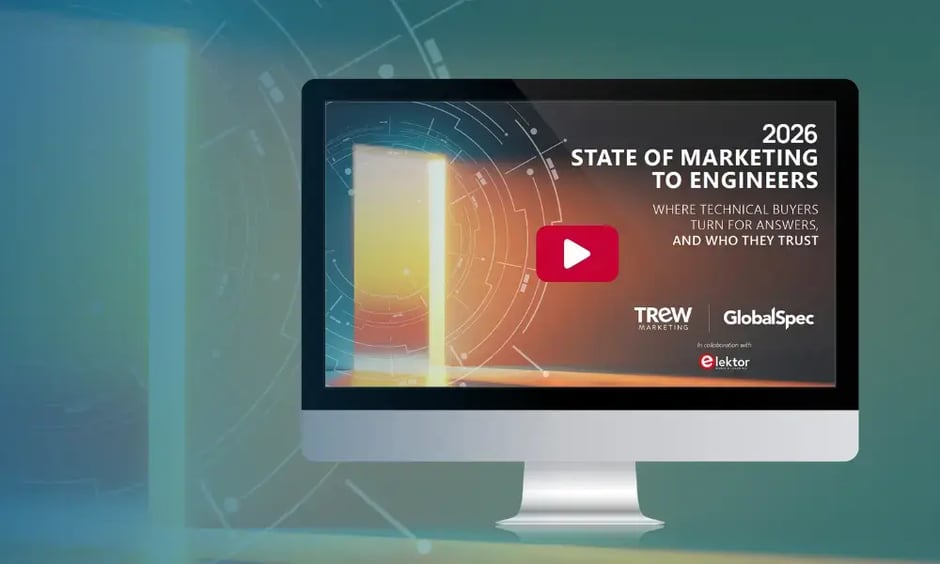
Missed the live webinar? Watch it on-demand.
Your Questions. Answered.
Audience & Strategy
Many questions centered on a familiar challenge: how to translate broad research insights into focused, actionable strategies, especially when your audience isn’t one-size-fits-all.
Was the audience B2B only?
Yes. The survey focuses specifically on engineers and technical professionals making work-related purchasing decisions, meaning the insights are grounded in B2B buying behavior.
Were data centers included in the survey audience?
While the report doesn’t isolate “data centers” as a standalone segment, respondents span a wide range of industries including electronics, energy, automation, and communications—many of which intersect with data center applications.
In the research, you note that you have few Gen Z respondents. How can you reach Gen Z next year so that we get more insight into where they get their information?
We are working on a plan for this, and are as eager as you to more deeply study Gen Z buyer behavior.
Have you asked whether buyers rather buy directly from a vendor (OEM) or rather through a trusted wholesaler they regularly buy from?
We have not asked this question before, but will consider it for our 2027 report.
How should you approach segmentation when your audience is very broad?
Start with use cases, not job titles.
Technical audiences may share a title (e.g., “engineer”), but their challenges vary widely. The most effective approach is to:
- Segment by application or problem type
- Align content to specific engineering workflows
- Build content clusters around those themes
This aligns with the research finding that engineers are highly self-directed — 62% of the buying process happens before they contact sales — so relevance early in the journey is critical.
How do you identify the right topics for engineers?
The best content strategies aren’t built on assumptions. They’re built on feedback loops.
Start by publishing content tied to real engineering applications, then monitor how your audience engages. Which topics drive clicks, downloads, or deeper engagement? Those signals tell you where to invest further. Over time, this approach allows you to expand high-performing topics into more in-depth formats and build a content ecosystem grounded in what engineers actually find useful.
Buying Process
Questions in this section focused on timing — when engineers engage, what prompts action, and how formats like webinars fit into the broader journey.
What was the webinar attendance frequency—per month or per year?
The data is measured annually.
- 91% of technical buyers attend at least one webinar per year
- 49% attend more than three
This reinforces that webinars remain a key format for deeper technical learning and evaluation.
What has your experience been if sales engages the interested party during their research journey?
The data shows us that technical buyers are not keen to interact with sales early in their buying journey. One of the biggest mistakes we see is early aggressive sales outreach when a prospect fills out a form for content. The connect and conversion rates are low, because the majority of the time that buyer is looking for education and is not ready to buy. We see that buyers want helpful content and tools such as configurators that they can use to research independently until they are ready for a coversation with sales. We do see much success with sales indirectly engaging through connecting (not selling) on LinkedIn, and then regularly posting authentic, helpful content to stay top of mind and build trust.
What makes engineers finally talk to sales?
Engineers typically reach out to sales when they’ve hit the limits of self-service research. At that point, they’re looking for clarity...whether that’s understanding a complex solution, validating what they’ve already learned, or getting specific details like pricing and availability.
This reinforces a key shift: sales conversations are no longer the starting point. They’re a continuation of a process that has already been well underway.
Content & Channels
As expected, there were plenty of questions about where engineers spend their time and what types of content actually earn their attention.
Based on your research, do you know what kinds of things engineers are looking for on YouTube? Is it primarily "how-to" kinds of things, video tours, shorter-form videos, longer-form videos, etc?
Engineers turn to YouTube for content that helps them do their jobs better. Instructional videos, product demonstrations, and in-depth technical explanations consistently perform well because they provide practical value.
While shorter videos can be effective for quick answers, engineers are willing to invest time in longer-form content when it helps them understand a concept, evaluate a product, or solve a problem.
Is YouTube also top in Asia? (asking since its blocked in China)
Yes, YouTube is the #1 most valuable social media platform for respondents from Asia-Pacific, with 82% of respondents rating YouTube as somewhat or very valuable.
Are engineers trusting video ads (like YouTube ads)?
Trust isn’t tied to the format — it’s tied to the substance. Engineers respond to content that demonstrates expertise and delivers useful information. If a video ad feels overly promotional or lacks technical depth, it’s unlikely to resonate. But when it teaches something meaningful or shows real-world application, it can absolutely earn attention.
Do engineers still find value in trade shows?
Yes, but their role has shifted. Most research happens online, but trade shows remain a critical moment for validation. Engineers use them to see products firsthand, ask deeper technical questions, and confirm decisions they’ve already been leaning toward.
Do you all have any information on the value of articles in printed technical publications? We get calls all the time from companies trying to sell us space in printed publications and I'm always hesitant, especially if there's no digital version of the publication also available (or the digital version are just a digital version of the magazine that's not searchable).
Print continues to play a supporting role, particularly when it comes to credibility. In an environment where digital content is abundant, curated print publications can stand out as more deliberate and trustworthy. They’re not replacing digital channels, but they can reinforce your presence and authority.
How should companies think about Reddit?
There are two main ways to use Reddit for marketing: organic community content, and advertising.
Ads on Reddit are targeted by subreddit, keyword search, or retargeting to past website visitors. They can be an effective way to reach a technical audience if that community is highly engaged in Reddit (which you can tell by searching for relevant topics, and seeing how active each subreddit is). They work best for brand awareness in this space vs traffic or lead generation, based on our tests.
Organic content is harder. Reddit users are very anti-marketing, and most subreddits have rules banning self-promotion. Organic content has to be genuinely useful. The best way to start with organic content is to have a subject matter expert engage with the community through answering questions, chiming in on discussions, and offering real value (without always mentioning your company). Aim for 10 genuine interactions for every 1 company mention to keep on the communities' good side, and pay attention to how those company mentions are received to avoid being banned.
How does Reddit play into this on social? I have two campaigns running in Reddit and the traffic accounts for 18% of my website traffic. I am curious if anyone else uses Reddit and if you see the value.
When asked how valuable various social media platforms are when seeking information for work, 30% of respondents rated Reddit as somewhat or very valuable. This put it in position 5, right behind Stack Overflow. This varies by region; Reddit is the #4 most valuable social platform with respondents from the Americas and Asia, was #5 with respondents from Europe, and did not make the top 5 platforms for respondents from Africa.
At TREW, we’ve run a couple ads recently on Reddit and have found it to be effective for brand awareness, but less effective for traffic and lead generation compared to other digital ad platforms.
How important is the “messenger” in technical content?
It’s critical. Engineers don’t just evaluate information, they evaluate the source. Content delivered by credible experts carries significantly more weight than content that feels anonymous or overly branded.
In many cases, who is saying something matters just as much as what is being said.
Generative AI & Search Behavior
AI sparked some of the most nuanced questions. Less about whether engineers are using it, and more about how much they actually trust it.
Does being present in more digital mediums positively affect your chances of being recommended by LLMs (ex. having a Youtube channel, LinkedIn account, podcast, etc. for your company)
Yes, but only when the content is credible and consistent.
LLMs tend to surface information that appears across multiple trusted sources. That means your presence on platforms like YouTube, LinkedIn, and technical publications can reinforce your visibility, especially when paired with accurate, high-quality content.
Since Google and Bing have AI results in first place of their search results, more engineers may use AI than they realized. Was this considered?
Yes, when asked “have you noticed summaries or overviews at the top of search results that appear to be AI-generated (e.g. in Google or Bing)”, 75% of respondents answered yes. Only 10% of respondents said no, and the remaining 15% responded not sure.
Of the respondents who have noticed AI-generated summaries, 69% of them read the summary and then continue to look through the search results. Only 6% responded that they read the summary and it’s usually enough.
What are engineers actually using AI for?
AI is primarily used in the early stages of research. Engineers leverage it to explore topics, summarize information, and get a starting point; however, they rarely stop there.
Most continue digging into primary sources to verify accuracy and gather deeper insights, highlighting the continued importance of trustworthy, human-created content.
Are there concerns that have been raised about using Generative AI to assist with creating content, such as technical blogs?
Yes, engineers are skeptical of:
- Whether the information is accurate
- Lack of information source transparency
- Generic, low-quality output
With trust in AI at just 4.7 out of 10, content must still be grounded in real expertise and credibility.
Do you think engineers will start trusting physical media more (ex. flyers distributed at trade shows or mailed to offices) to avoid “AI Slop” online?
There are early signals that curated, high-quality sources — both digital and physical — are gaining importance as a counterbalance to low-quality, AI-generated content. That doesn’t mean a return to offline-only strategies, but rather a renewed emphasis on credibility across channels.
Credibility is the competitive advantage
Across every question, one theme continues to surface: engineers are navigating more information than ever — but they haven’t lowered their standards.
-
They’re using AI, but verifying what they find.
-
They’re exploring new platforms, but relying on trusted sources.
-
They’re consuming more content, but filtering it more carefully.
For marketers, that means the goal isn’t just visibility. Its credibility.
The companies that stand out aren’t the loudest. They’re the ones that consistently provide clear, useful, and trustworthy information — meeting engineers where they are and helping them move forward with confidence.
Missed the live webinar? Access the 2026 State of Marketing to Engineers on-demand recording.
To follow along as Wendy Covey, CJ Haight, and Udo Bormann dive into this year's research findings, download the full report.
If you'd like to see how this year's results compare to previous research findings, access our research archives.
TREW Marketing partners with engineering and B2B technology companies to elevate their brand, engage their audiences, and generate new opportunities through insightful research and unrivaled industry expertise. Contact us today to learn more about the services we offer.
Wendy Covey
.png?width=80&name=Wendy_square%20(2).png) Wendy Covey is a CEO, a technical marketing leader, author of Content Marketing, Engineered, one of The Wall Street Journal’s 10 Most Innovative Entrepreneurs in America, and she holds a Texas fishing record. She resides in a small Hill Country town southwest of Austin, Texas, where she enjoys outdoor adventures with her family.
Wendy Covey is a CEO, a technical marketing leader, author of Content Marketing, Engineered, one of The Wall Street Journal’s 10 Most Innovative Entrepreneurs in America, and she holds a Texas fishing record. She resides in a small Hill Country town southwest of Austin, Texas, where she enjoys outdoor adventures with her family.
About TREW Marketing
TREW Marketing is a strategy-first content marketing agency serving B2B companies that target highly technical buyers. With deep experience in the design, embedded, measurement and automation, and software industries, TREW Marketing provides branding, marketing strategy, content development, and digital marketing services to help customers efficiently and effectively achieve business goals.